Process piping in pharmaceutical manufacturing has to meet strict quality and documentation requirements before systems move into turnover, startup, and commissioning.
AM Technical Solutions (AM) recently successfully completed a third-party weld inspection assignment for a pharmaceutical manufacturing project in California. Our team supported the process piping scope through independent inspections, Positive Material Identification testing, non-conformance management, and electronic turnover documentation.
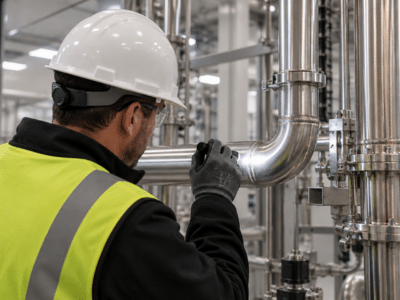
AM conducted the inspections at both the project site and the mechanical contractor’s fabrication shop. AM inspectors worked alongside the construction, design, and mechanical teams to verify that process piping installations met project requirements and applicable industry standards.
Our Project Support for Process Piping Inspection
AM staffed the project with Level II certified inspection resources and adjusted staffing as construction activity increased. The inspection program supported process piping systems governed by ASME B31.3, ASME BPE, and project-specific requirements.
The weld inspection scope covered weld coupon reviews as well as external and internal visual inspections. Results were documented according to the project’s weld assurance requirements and incorporated into the mechanical contractor’s turnover process.
AM also performed Positive Material Identification testing to verify piping materials against project requirements. When deviations were identified during inspections or PMI testing, our team generated and tracked Non-Conformance Reports through resolution.
The work required consistency. Each inspection had to support the immediate quality needs in the field while also producing documentation that would remain useful later in the project.
Connecting Inspection Work to Project Turnover
AM organized the inspection records through an electronic Turnover Package. The package included PMI reports, calibration records, inspector certifications, applicable certificates, inspection reports, and Non-Conformance Reports.
That process aligns with AM’s Early Quality Integration approach. Quality requirements are established early, inspection information is organized as work progresses, and downstream startup and commissioning teams receive access to documentation they can use during later phases of the project.
For hygienic piping systems, the piping isometric serves as a central reference point for connecting inspection records with supporting documentation. AM’s web-based eTOP platform allows authorized project team members to process and track turnover information in one place.
That gave the project team a structured record of completed inspection work as the process piping systems moved toward turnover.
Supporting Quality Throughout Construction
The lead inspector assigned to the project brought experience in process piping, welding techniques, mechanical assembly, technical drawings, and standards including ASME BPE and B31.3.
AM combined field inspection with material verification, issue tracking, and turnover documentation throughout the assignment. The result was a coordinated third-party inspection program built around the quality requirements of a pharmaceutical manufacturing project.
– Find out more about our capabilities to support third-party inspection and quality services for Life Science projects.
– View our Portfolio of high-tech construction and quality projects.
– Does your team need weld inspection or process piping inspection support for a pharmaceutical project? Contact us today to discuss your project requirements.